|
New York, New York THE BASICS Author: Barbara Hayo www.TrustedTours.com |


Weather
New York's climate is temperate, with four distinct seasons. It’s delightful in the spring, crisp in the fall, cold in the winter and heats up in the summer. Temperatures are mild and pleasant in April, May and June. The days are still warm in September, but the nights cool down. Crisp air and blue skies herald in October and last through November. December is cold, but with the festive spirit that overtakes the city as shopping bag-laden holiday crowds stream in and out of lavishly decorated stores, it’s easy to stay warm.
Month |
High (Fahrenheit) |
Low (Fahrenheit) |
| January | 39� | 26� |
| February/ March | 44� | 30� |
| April | 48� | 34� |
| May | 61� | 44� |
| June | 81� | 63� |
| July/ August | 84� | 67� |
| September | 77� | 60� |
| October | 67� | 51� |
| November | 54� | 41� |
| December | 41� | 30� |
Seasons and Seasonal Annual Events
January and February are the coldest months of the year and the concrete canyons of the city can feel like bitter wind tunnels. However, hotel rooms are not in as great demand and may be a bit cheaper. Nice cold weather perks are Restaurant Week, when participating restaurants serve prix-fixe dinners at more affordable prices, and shorter lines and more readily available tickets for Broadway shows.
 In February, dog lovers can watch the very best of their breed strut their stuff during the Westminster Kennel Club Dog Show at Madison Square Gardens. It’s also a time to visit Chinatown to watch the dragon dancers snake their way through the streets and sample exotically prepared seafood and vegetables, tasty dim sum and wonderful custard cakes served from outdoor stands and stalls during the Chinese New Year Celebration, a two week period which falls sometime in February, depending on the year.
Wear your green in March and stake out a spot along Fifth Avenue between 44th and 86th Streets for an up close view of bands, bagpipers and marchers in the St. Patrick’s Day Parade. In March, “get yours at the Pier,” at the city’s largest and most comprehensive art, antiques and vintage fashion event held in Pier 88, 90 and 92 along the Hudson River, the Triple Pier Antiques Show (also held in November). In April immerse yourself the world of New York film at the trendy Tribeca Film Festival.
Beginning in May, New Yorkers head outdoors, taking in the multitude of activities of the warm summer months. For many, this is the best time to experience New York as it is a time to truly engage with the city. There are festivals, music events, outdoor theatre and colorful parades. May brings out throngs of people to sample ethnic dishes and typical New York fare prepared and presented in booths along 9th Avenue, between 37th and 57th streets during the Ninth Avenue International Food Festival, a local favorite. At the end of May, the Navy invades during Fleet Week, opening aircraft carriers and a variety of other ships to the public for tours.
Parades celebrate most every aspect of the city’s ethnic heritage and June is Puerto Rican Day Parade, with floats, great music and some of the most celebrated pop vocalists, Jennifer Lopez, Mark Anthony and Ricky Martin, drawing huge crowds. Fifth Avenue between 82nd and 104th streets, closes to cars for one day in June, a rare luxury, for the Museum Mile Festival and New Yorkers and tourists stroll the avenue, enjoying live music along the way and free admission to nine Museum Mile cultural institutions.
Summer is a time when concerts often are alfresco, many are free, and the wait for a restaurant table may not be as long as it is in spring and fall. Restaurant Week happens again in June. Central Park becomes a wonderful venue for exceptional outdoor performances including Summer Stage, featuring a wide range of music, from pop to opera, and Shakespeare in the Park, a traditional summer favorite.
July starts off with a bang at the Independence Day Harbor Festival in lower Manhattan and the Macys 4th of July Fireworks Spectacular, an extravaganza of fireworks launched from barges in the East River, the most awesome in the country. Throughout July, the multiple venues at Lincoln Center present the best opera, ballet, theatre at the Lincoln Center Festival and, during the entire month of August, the outdoor plazas of the Center become summer venues for Lincoln Center Out of Doors, a series of free music and dance performances. During August, Harlem showcases “uptown style” and the African-American, Latino and Caribbean-American heritage of this historic neighborhood during Harlem Week events: the Black Film Festival, the Taste of Harlem Food Festival, and the Harlem Jazz and Music Festival.
From fall to early spring, theatre and the performing arts peak. Broadway shows are in full swing, new museum exhibits open and galleries have grand openings. At the end of September, the New York Film Festival shows highly anticipated premiers at various venues at Lincoln Center, a key stop on the world film festival circuit. In October, skating rinks about town begin to open, including at Rockefeller Center and Central Park. In November, the Chocolate Show in Chelsea satisfies every craving, and millions line the streets or watch the annual Thanksgiving Day Parade.
New York does the Holidays in grand style. It’s the busiest season, the most crowded time of year, but no one seems to mind. People carrying multiple bright packages bustle about, Fifth Avenue is trimmed and festive, stores and buildings glitter. The unveiling of holiday displays in department store windows is eagerly anticipated, and shoppers come from all over the world to find the perfect holiday gifts. There is skating at Rockefeller Plaza, the giant Christmas Tree is a must see, the New York City Ballet performs The Nutcracker at Lincoln Center, the Christmas Spectacular is truly extravagant in Radio City Music Hall, A Christmas Carol is presented at the Theater at Madison Square Garden, and of course, the lighted ball drops heralds in the new year in Times Square.
Population
With over 8 million people living in five boroughs, New York is the most populated city in the United States. With approximately 36% of its population being foreign-born, it is the country’s most diversely populated city. Historically a city of immigrants, the 2.9 million foreign-born residents in the 2000 census was the largest number in the city’s history, and 43% of these have arrived since 1990. As a result of the continuing influx of immigrants, over 40% of the city’s labor force is from other countries, particularly noticeable in the service industry, in hotels, restaurants, stores and in transportation.
New York is more than a melting pot – it is a world city. Historically a magnet for immigrants, it is demographically dynamic. Changing U.S. immigration laws have had a direct impact on the nationality make-up of New York’s population. While in the 19th and 20th centuries, immigrants came from Europe, the largest sources of immigration in the beginning of the 21st century have been from the Dominican Republic, China, Jamaica, Guyana, Mexico, the Philippines, India and the former Soviet Union. As newly arrived immigrants gravitate to neighborhoods where they have family or friends, New York City’s tradition of colorful ethnic enclaves continues.
Size
Five boroughs – Manhattan, Brooklyn, Queens, the Bronx, and Staten Island make up New York City’s 321 square miles. A coastal city at the mouth of the Hudson River on the Atlantic Ocean, it is mostly surrounded by water, a contributing factor in its ranking as the most densely populated city in the U.S. Much of the city is built on three islands: Manhattan Island, Staten Island and the western end of Long Island. The Hudson River separates the New York City from neighboring New Jersey. The city’s boroughs are also separated by water: the East River separates the Bronx and Manhattan from Long Island, and also separates Manhattan from Queens and Brooklyn. The Harlem River separates Manhattan from the Bronx.
The global commercial, cultural, financial and tourism center of Manhattan is only 2 ½ miles wide and 12 ½ miles long, a total of 22.6 square miles. If Manhattan feels crowded, it is - over 1.5 million people live on this small island land mass, and every weekday, millions more stream in to work from their homes in the other boroughs and from the suburban “bedroom” communities in Connecticut and New Jersey.
Transportation
Subway: Everyone, some 3.5 million daily, including the Mayor, gets around by subway.
Important Subway Tips:
- Get a subway map.
- Most lines run north (uptown) and south (downtown), the same as avenues. Know if your destination is uptown or downtown and be sure your line goes that way.
- Lines are color-coded and have a letter or number. They are commonly called by their letter or number, not by their color.
- Determine which subway line serves your destination.
- Most sites publish which lines access them.
- The subway runs 24 hours a day, 7 days a week.
- To ride, use a MetroCard, a debit card that subtracts the fare at the turnstile.
- Purchase MetroCards from token booths, at vending machines located in subway stations, through MetroCard merchants in certain other high traffic areas.
- The $2 fare will get you to any subway line served without exiting the station.
- Multiple ride cards, Pay Per Ride and Unlimited-Ride MetroCards are available.
Bus: Almost every major avenue in Manhattan has a bus route, running either north (uptown) or south (downtown), but not both. Crosstown buses run east and west. Bus stops are located on the right side of the street, every few blocks, designated by blue and white bus signs. Most stops have a map on the bus sign, so you can see its route. Busses operate 24 hours a day for a fare of $2.00, payable with a pre-purchased Metrocard, the same card you purchase for subways, or for exact change.
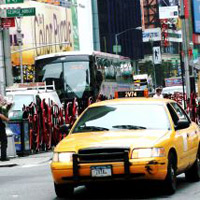 Cab: Hailing a cab is competitive business. Glance at the medallion light on top of an approaching cab. It is available if only the center portion illuminating the cab numbers is on. Stick out your arm and act fast. Jump in as soon as it stops and as you do so, tell the driver where you want to go by giving him the name of your destination, the avenue it is on and the cross street. While the name of well-known sites is often sufficient, don’t assume that it is. For clarity’s sake, for example, to get to the famous icon, the Waldorf Astoria at 301 Park Avenue, simply say, “the Waldorf Astoria, Park Avenue, between 49th and 50th streets.” Be sure to tip your cabbie.
Walking: There is always traffic gridlock in New York, making walking, more often than not, the quickest way and best way to get around. You may walk a long way, but you’ll get there and see plenty along the way! Move quickly, with the crowd, and be sure not to jaywalk, you can get ticketed or run over! Seasoned New Yorkers will cross any which way they choose, but don’t follow their example…wait for the crossing light.
Car: Only the initiated would even try driving in New York City.
Accommodations
With more than 57,800 hotel rooms in Manhattan, there are many accommodation choices. An on-going hotel construction boom, combined with major renovations of many older hotels, is expected to increase that number by 5.3% in 2007. A popular year-round global destination for business and pleasure, New York City’s hotel occupancy rate of 85.1% and average room rates of $221.57 are the highest in the country.
Hotels in Manhattan can be splendid, exclusive, grand, iconic, elegant, sparse, discretely tasteful or predictably bland. They can be retro, deco, futuristic, artistic, minimalist. They can offer the best amenities and services available, or can be rooms with shared baths. They can cater to the leisure traveler, the techno traveler, or families with kids. There are reliable chain hotels, glossy, trendy hotels frequented by the superhip, hotels with a European intimacy, quaint guest houses, or small charming hotels tucked away down historic streets of neighborhoods like Chelsea and Greenwich Village. Visitors often choose the convenience of a Midtown hotel, within walking distance of many prominent sights. However, a wonderful Manhattan experience can be found in a hotel in one of the city’s neighborhoods, which also offer great restaurants and nightlife. If not within easy walking distance of major attractions, they are but a quick subway ride away.

Trust us, we've been there!
www.trustedtours.com