|
San Francisco, California OFF THE BEATEN PATH Author: Barbara Hayo www.TrustedTours.com |


The sense of discovery in finding something hidden and unique is part of the magic San Francisco. Here are some gems for starters: 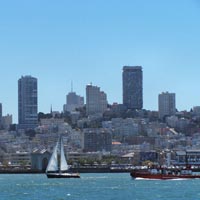
Find a stairway walk and take it! San Francisco has many of these magical places that weave their way up hills through secret gardens, only to open up to fabulous views. These unique stairways were built when the summit end of a street was too steep to be accessed by car or cable car. Stairways were built to reach the homes built at the top. Best known are the Filbert Stairway leading up to Coit Tower on Telegraph Hill, Lombard Street Walk, Baker Stairway in Pacific Heights. However, there are many more less-traveled. Adah Bakalinsy�fs Stairway Walks in San Francisco highlights some of these unique treasures.
Admire San Francisco's distinctive residential Victorian architecture, her Painted Ladies, layered in turrets and bay windows, with decoratively embellished, colorful facades, These late 19th century gems are found all over the city, but a grand cluster of them is in the Alamo Square Historic District, bounded by Divisadero St., Golden Gate Ave., Webster St. and Fell St.. Originally painted white, gray, black and brown, they have been gloriously restored in picture-postcard ways.
Visit the Muse�Le Me�Lcanique in Fisherman's Wharf, often overlooked in this busy area. Filled with coin-operated, one-of-a-kind, mechanically operated games and musical instruments, it�fs an amusing and nostalgic trip into the early 20th century carnivals and entertainment arcades.
Discover San Francisco's European Quarter, tiny Belden Lane, where Chinatown, the Financial District and Union Square converge. A bit like Montmartre, lunching at an outdoor table in a French bistro is a real treat.
Walk out into the bay on a pedestrian pier, discover seafood shacks and rustic saloons along the Embarcadero. Tucked in among the commotion of busy ferry piers, shopping and entertainment complexes are lingering hints of the waterfront�fs past. From the Ferry Building, walk to Pier 7, a pedestrian wharf jutting 900 feet out into the bay, and look back at the city view. It�fs spectacular. A bit further down, stop at a seafood shack, Pier 23 Cafe�L, for a quick lunch overlooking the bay. Venture west off the Embarcadero to Battery St., near Front and Pacific streets. Beneath the sign bearing a model of the ship, the Arkansas, is the Old Ship Saloon, a notorious bar dating to 1849. Originally a bar in the bow of the sailing vessel the Arkansas, which had been abandoned by its crew during the gold rush, it was covered by landfill and replaced by the current building in 1907.
On Maiden Lane, lined with upscale stores, look for the distinctive Frank Lloyd Wright designed building, with the look of a mini Guggenheim. It houses the Xanadu Gallery, folk art from all over the globe.
Seek out the mural art of San Francisco, a colorful art form expressing the social issues of the common laborer. A vast number are painted on buildings in the Mission District, a vibrant neighborhood of Latino families, filled with bodegas and taquerias. These remarkable works are painted on buildings, down main streets and along the length of alleys. Special ones include the murals along Clarion Alley, the ones down Balmy Alley, and the huge Maestrapeace on the Women�fs Building on Dearborn at 18th St.. For information and mural tours of the Mission District, contact the Precita Eyes Mural Arts & Visitors Center. If the Mission District is out of the way, see the incredible murals in Coit Tower, all frescos, painted by a group of individual artists in the 1930s, and each a social statement of the plight of laborers. Or, see the fabulous fresco by the most famous of muralists, Diego Rivera, who inspired much of city�fs pro-labor art of the 1930s, in the San Francisco Art Institute. All are remarkable.
For the rugged individual, a stay in the rustic West Point Inn, where there is no electricity, is an unusual get-away! Once a stopover on the Mill Valley/Mt. Tamalpais Railway, it is a camping experience with phenomenal views. Bring your own linens to spend the night in a cabin illuminated by gas light. Bring your own ingredients to cook over gas stoves in the communal kitchen. Sit by the fireplace in the common living area or on the deck overlooking the bay. If camping is not your style, just go for a visit, but be prepared to walk over a mile from the parking area to get the inn.
Listen to a symphony of land and sea created by the Wave Organ, a man-made, wave-activated sculpture located at the end the jetty just past the St. Francis Yacht Club in the Marina District. At high tide only, musical resonations combined with sound of the surrounding environment, emanate from listening tubes sticking up like periscopes among carved granite blocks. Constructed of stone from an old gold rush cemetery by artist Peter Richards and sculptor and stone mason George Gonzales, it is a masterpiece of physics, engineering and design. The sound is subtle, the view amazing.
Explore the hauntingly beautiful Land's End, where San Francisco meets the Pacific. Coastal trails lead to secluded beaches and landmark buildings, including remnants of the long-abandoned swimming pools of Sutro Baths, a modern ruin of the excess of the Gilded Era. Walk up picturesque stairways, lunch at the Cliff House, hanging out over the Pacific, see seals lounging on Seal Rocks, climb down to Baker�fs Beach, enjoy 20th century European art masterpieces at the Palace of the Legion of Honor.
Stand almost over the San Andreas fault along the 1906 Earthquake Trail in Point Reyes to understand the geological forces behind the region's earthquakes, including the one that destroyed much of San Francisco in 1906. Located in the Point Reyes National Seashore in Marin County, it�fs different, interesting, and free.
Ferry out to Angel Island, the largest island in San Francisco Bay, at one time a whaling anchorage, military fortification, quarantine station, disembarkation point for soldiers in both World Wars, a Nike missile base in the 1950s and 60s, and the �gEllis Island of the West,�h through which Asian immigrants passed from 1909 to 1940. See dozens of faded Chinese poems of despair inscribed on barrack walls in the Immigration Station; enjoy a tram ride around the island; rent a bike; take a Segway tour; take a sea-kayak tour. In the summer months, lunch in the Cove Cafe.

Trust us, we've been there!
www.trustedtours.com