|
San Francisco, California THE AMBIENCE & HISTORY Author: Barbara Hayo www.TrustedTours.com |

Urbane, cosmopolitan, sophisticated, diverse, tolerant, artistic, gritty. San Francisco is all these and more. It is, as James Michener described, "the most varied city in America." A city of contrasts and extremes, it's conventional and controversial, counterculture and yuppie establishment. It's wine country and Haight-Ashbury; the birthplace of Levi jeans and the Grateful Dead. Even the famous fog is sometimes there, sometimes not.
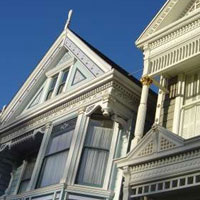
San Francisco impacts the senses. Compact and windswept, with cliffs hanging over a turbulent sea, it sparkles in the brilliant sunshine, or disappears under a shroud of fog. Picturesque Victorian buildings are improbably built up, down, and around the swells of 43 hills. Flowers hang in baskets and drape over window boxes. Sea lions bark from sun perches on rocky cliffs. The tips of Golden Gate Bridge peek out, like angel wings, over the stillness of the billowing fog, Alcatraz looms forbiddingly in the bay, and the 360� vista from the 900 foot high Twin Peaks is breathtaking.
San Francisco is being chilly enough to need a wrap, only to shed it as the brilliant sun bursts through the fog. It's driving in low gear down zig-zagging Lombard Street, exhilarating walks up impossibly steep streets, or hopping on a famous San Francisco cable car for a climb up Nob Hill, and a gut-gripping descent down Hyde Street.
It's a city where the preparation and presentation of exotic food is an art form, and dining a global adventure. Mounds of Dungeness crab piled on carts along Fisherman's Wharf, tasty morsels hidden in steaming dim sum in Chinatown, and baskets of tangy sour dough bread call out to passersby. Meaty Vietnamese banh mi, hot and spicy Sichuan beef, crispy Cantonese roast duck, savory Italian risotto quattro fromaggi, Japanese Koryori, divine foie gras, and fabulous seafood cioppino can be sampled in wonderful spaces, simple or elegantly nouveau.
Shopping choices are as varied as San Francisco itself. Browse through the Chanel Boutique on exclusive Maiden Lane; pick out vintage clothing at Aardvark's. Find the perfect gift at Gump's in Union Square, the best remedy at Great China Herb Company, a great read at City Lights Booksellers. Forage for fresh organic produce at the Ferry Building Market Place & Farmer's Market, bite into a Joseph Schmidt Confections' chocolate creation, indulge in a sundae at Ghirardelli Square.
The isolated tip of the 32-mile rugged peninsula swelling with hills between San Francisco Bay and the Pacific Ocean was an unlikely place to build a city. San Francisco evolved as a circumstance of its geography and geology.
Fog hid the great bay from the early explorers prowling the coast. Once discovered by the Spanish in 1775, its destiny as a conduit of people and goods began. In the mid-1800s, the discovery of gold veins and silver lodes in nearby hills brought entrepreneurs and risk takers - people who believed that anything was possible and who tolerated the differences among them. Earthquake-causing fault lines running beneath the city created a community of grit, resolve, and determination.
After staking claim to the bay, the Spanish built the Presidio, a sentry for its entrance. Today, the Presidio of San Francisco National Park is a wooded haven of nature trails and historic buildings, legacies of its various military roles. The Spanish added permanence to their claim by building the first of several missions in the region, Mission Dolores. Located in the Mission District, it is a tangible reminder of Spain's early presence.
Mexico took over Spain's holdings in 1821, and the area changed dramatically. Large tracts of mission land was given to settlers to encourage population growth, holdings which evolved into huge cattle ranches, "ranchos," down the peninsula and across bay, setting the stage for the corporate agricultural lands and vineyards of modern California.
Lured by tales of vast and fertile land, hardy Americans from the east coast journeyed around Cape Horn or across the plains and the Sierras to get there. A settlement of adventurers and globe-trotting traders sprang up around a cove on the northeast side of the peninsula, away from the wind and treacherous bay currents. As the town grew inland from the cove, streets were laid out over steep hills, with Market Street the center of town. The American flag was raised over the city in 1846, and the name changed from the original, Yerba Buena, to San Francisco in 1848.
On January 24, 1848, everything suddenly and turbulently changed for rugged town of 500 - gold was discovered. People from all over the globe rushed in, eager to strike it rich. The population exploded to over 30,000, in a burst of languages and cultures. This extraordinary mix of people living together in chaos had but one thing in common - the belief that anyone, regardless of background, could attain riches. It was from this attitude that the "49er" legacy was born - a risk-taking attitude and a "laissez-faire" acceptance of human differences.
San Francisco of 1849 was a lawless, chaotic, dangerous, decadent encampment of wood shacks, strung with canvas. Its predominantly male population lived with few social taboos. Miners came down out of the hills with bags of gold, ready to spend it on gambling, drinking and prostitution. Crime was rampant. Establishments serving every kind of ethnic food popped up to meet the demands of people from all over the globe looking for the taste of home, setting the precedent for today's culinary diversity.
Docks were built out to deep water to accommodate the global fleet of merchant ships. In later years, these docks, along with sailing vessels abandoned in place by their crews during the gold rush frenzy, were covered by fill, entombed forever below street level in what is now the Financial District. Permanent buildings replaced temporary ones, and the city began to take shape. Businesses sprang up to serve the mining industry - timber to build the mines, cattle and agriculture to feed the miners, manufacturers and importers of goods to supply them - many of whom evolved into the giant industries of today.
The gold rush led to San Francisco's present-day status as the banking and finance center of the west. Banks sprang up, first to mint gold into coins, later to lend money to capitalize mining ventures. Wells Fargo Bank was founded in 1852 to buy gold, sell paper bank drafts and provide rapid delivery of valuables overland. The rags to riches story of the early frontier town is told through displays of real coaches, gold dust and ore, artifacts and photos in the Wells Fargo History Museum in the bank's main office. Bank of America, the nation's largest consumer bank, whose distinctive black granite world headquarters rises above the skyline, was founded in San Francisco as the Bank of Italy, a major force in the city's reconstruction in the aftermath of the 1906 earthquake.
Merchants from all over the world came to sell goods to miners, laying the foundation for the city as a shopping mecca. Levi Strauss, a German immigrant, came up the idea to use sturdy denim fabric for miners' clothing. Levi Strauss & Co., still run by the Strauss family, is headquartered in the award-winning Levi Plaza at the foot of Telegraph Hill.
Freight and steamship lines formed to move people and goods. In a major effort, the Central Pacific Railroad, the California to Utah portion of the first transcontinental railroad, was built on the backs of thousands of Chinese, who immigrated en masse in 1848. Intense discrimination experienced by the Chinese led them to retreat into a self-sustaining enclave that became today's busy, bustling Chinatown.
As gold yields lessened, geology once again propelled San Francisco's fortunes. This time it was through silver, discovered in 1859. In the enormous wealth that flooded the city, quick fortunes were once again made in finance, timber, transportation, and supply manufacturing, and goods coming in from other countries kept the docks bustling.
The docks were also busy with bounty from the seas. In the late 1800s, San Francisco was the whaling capital of the world, and fishermen also hauled in huge catches of king salmon, Pacific herring and Dungeness crab. Much of this activity was centered in the area now called Fisherman's Wharf, where tourists from all over the globe come to enjoy shops, great seafood restaurants, and attractions. The San Francisco Maritime National Historical Park, which includes historic sailing vessels moored at the Hyde Street Pier, tells the story of the port and its contribution to the city's character.
The newly rich, flush with silver wealth and eager to show off their cosmopolitan tastes, built grand buildings. The opulent Palace Hotel on Market Street, built 1875, was the largest in the U.S., and a magnet for the rich and famous. It was one of the casualties of the fire of 1906, but was soon rebuilt to its former prominence. Today, Sunday Brunch under the huge chandeliers and magnificent stained-glass ceiling of the spectacular Garden Court is delightful opportunity to journey back to the Gilded Age.
In 1873, the cable rope technology used to move ore up out of mines led to the creation of San Francisco's new public transportation, the cable cars, now an iconic National Historic Landmark. Experience the thrill of riding the cable car up and down the steep hills, and see the actual cable mechanism at work pulling cars up the streets on a visit to the Cable Car Museum on Mason Street.
In the Gilded Age of the late 1800s, grand parks were in vogue in European and East coast cities. Not to be outdone, San Francisco created Golden Gate Park in 1870, out of the windy, sandy, barren western tip of the peninsula. In a city of few green spaces, trees, plants and lawns were painstakingly nurtured to grow there, attracting thousands of people daily, and the Midwinter Exposition, held in the park in 1904, showed the world how cosmopolitan the frontier town had become.
 But a life of opulence was only for a privileged few. Most of the population lived in the "Barbary Coast," at the foot of the hills around lower Pacific Avenue and Broadway, the area around now gentrified Jackson Square. It was filled with dance halls, bars, and saloons, and gambling, prostitution and opium smoking were a way of life. Vigilance Committees tried to curb vice and crime, but it took a geological event to control it.
On the morning of April 18, 1906, one of the largest earthquakes ever recorded in North America devastated the city. What the quake did not destroy, the fire in its aftermath did, spreading uncontrollably for three days, reducing 514 blocks to rubble.
The "anything is possible" spirit rebuilt the city in 3 years - in grand style. City Hall and the Civic Center were built in the ornate Beaux Arts style, popular in East coast cities and Europe. San Francisco again showcased its achievements at the Panama Pacific Exposition, held in what is now the Marina District, to celebrate the 1914 opening of the Panama Canal. As was Golden Gate Park before it, it was built on marshland, where 635 acres along the northern waterfront were filled with dredged bay sand.
Nothing, it seemed, could quell this "can do" attitude. During the Great Depression, the city spanned the bay with two massive bridges, the Golden Gate Bridge and the Bay Bridge. These were celebrated in San Francisco's signature grand style in yet another global fair, the Golden Gate International Exposition of 1939-1940, held on Treasure Island, the largest man-made island in the world, created just to host the fair.
World War II military base expansion brought newcomers who stayed. In reaction to the suburban blandness of the 1950s post-war America, counterculture took root in the city. The "Beat Generation" thinkers who gathered in North Beach, many at Vesuvio, to read poetry, drink wine and listen to jazz, established San Francisco as a magnet for counterculture movements. Hippies and flower children arrived in the 1960s, gathering in Haight-Ashbury, bonding through drugs, Janis Joplin and Jimmy Hendrix. San Francisco became the center of anti-Vietnam movement on the west coast, drawing 30,000 marchers to Golden Gate Park in January 1967 in the "Human-Be-In," and 100,000 more in April. In the 1970s, gays found acceptance in the city where "lavender cowboys" were once part of the uninhibited gold rush culture. Congregating in the area now called The Castro, unique shops, bars and restaurants proudly fly rainbow flags.
Diversity and acceptance give San Francisco its distinct identity, and the city's greatest legacy is its promotion of the rights of all people - minorities, women and gays. People from all parts of the globe, from all backgrounds - ethnic, cultural, social and sexual - participate expressively in their grand and beautiful city.

Trust us, we've been there!
www.trustedtours.com