|
San Francisco, California THE BASICS Author: Barbara Hayo www.TrustedTours.com |


Weather
San Francisco�fs most famous climatic feature is fog- surreal to see, dramatic to photograph, unusual to be in. It is San Francisco�fs geographic location- the combination of water, wind and hilly topography - that creates this unique feature. Primarily a summertime phenomenon, the warm air over the cold Pacific creates a fog bank lying off shore. As the land heats up, the fog funnels into the bay through the one of the few, and certainly the largest, opening in the coastal mountains, the Golden Gate. The fog usually burns off during the course of the day.
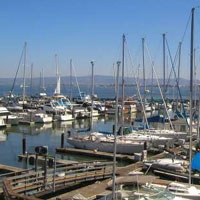
Overall, San Francisco has year-round sweatshirt weather - invigorating and delightful. The temperature differential from season to season is never extreme, but remains on the chilly side, summer and winter. The only thing predictable about the weather is its unpredictability, as it changes often in the course of a day, and from neighborhood to neighborhood. The average high in the summer rarely reaches much above 70 degrees; lows in the winter rarely dip below low 40 degreess. The warmest days are in the autumn, when the summer fog disappears and an Indian summer brings in temperatures that may reach the mid 70s. January and February, the coldest months, are also the rainiest, with cold wind coming in, often with vengeance. Between storms, days can be crisp and sunny.
The best advice is to always dress in layers which can be pulled off and on as needed. In the summer, the fog can be chilling, only to break to reveal brilliantly blue skies and a warm sun. The air coming off the Pacific Ocean can be cool, and a wrap is always welcomed during the day and necessary at night.
|
Month |
High (Fahrenheit) |
Low (Fahrenheit) |
| January- February | 57� | 45� |
| March- April | 63� | 47� |
| May- June | 68� | 52� |
| July- August- September | 72� | 55� |
| October | 70� | 52� |
| November | 62� | 48� |
| December | 56� | 43� |
Seasons
Mild year-round weather lends itself to outdoor activities and year-round festivals and fairs, celebrated along the streets of this interesting city. It�fs a great way to mingle with the locals and enjoy the essence and diversity of the city. Just remember, always dress in layers, regardless of season!
Spring. Spring in San Francisco (March-May) is a most inviting time, often with cloudless, mild days and infrequent showers. Everyone is Irish for a day in March during the St. Patrick�fs Day festivities around Union Square, the Civic Center, and along the Embarcadero. Try your hand at origami and flower arranging at the Cherry Blossom Festival along the blocked off streets of Japantown in April; see great film at the oldest American film festival, the San Francisco International Film Festival; dance in the streets to the music of mariachi bands at the Cinco de Mayo Festival in the Mission District; salsa down Harrison between 16th and 23rd in the Carnaval Festival, the Mission District�fs largest annual event. Scenic San Francisco hosts some great races, and one of the most entertaining is the Bay To Breakers 12K, where thousands of costumed walkers and runners have gathered in Golden Gate Park since 1912.
Summer. Fog dominating San Francisco in June-August does not deter art festivals held in various districts - upscale Union Street Arts Festival, alternative Haight-Ashbury Street Fair, nostalgic North Beach Festival. Take in a concert on the lawn at the Stern Grove Music Festival in Sunset District, jazz on the street at the Filmore Jazz Festival in Pacific Heights. Celebrate the 4th of July with fireworks at Fisherman's Wharf, a real extravaganza, if the fog doesn�ft settle in first.
Fall. When autumn leaves usher in fall in other parts of the country, September to November in San Francisco is delightful, with days warmed by air coming up from the Central Valley, and mild and clear nights. Ocean Beach and Baker Beach are layered with bodies soaking up the sun, boats cruise about the uncommonly glassy bay, and people flock to Golden Gate Park. Music in outdoor venues fills the air. Opera season is launched with a concert in Golden Gate Park; jazz is heard in multiple venues during the San Francisco Jazz Festival; the San Francisco Blues Festival, the largest outdoor blues festival on the west coast, takes place on the grounds of Fort Mason. The studios of hundreds of artists are open to the public at Artspan Open Studios, and art comes with wine and gourmet food across the bay at the Sausalito Art Festival. Diversity is celebrated along Fisherman�fs Wharf and in North Beach during the Columbus Day Italian Heritage Parade, and during the Castro Street Fair.
Winter. For 2 weeks in January in Dine-About-Town, over 100 participating restaurants offer special menus and pricing. January kicks off the San Francisco Ballet season, and serious wine tasting takes place at the Zinfandel Festival. In February, celebrate the New Year, Chinese style, at the Chinese New Years Parade, a fanciful, lighted night parade, and during the day, visit the New Year's Flower Market Fair. Enjoy the pageantry of the Vietnamese Tet Festival in Little Saigon, take in the explosion of color at the Tulipmania Festival at Pier 39, and the Pacific Orchid Exposition at the Fort Mason Center.
Population
The 2006 population estimate for San Francisco County is 744,041, 40% of whom are between the ages of 24-44. With a combined total of 89%, whites and Asians dominate the population, with a growing Hispanic population in several districts.
Size
Surrounded by water on three sides, the land area of the square-shaped San Francisco peninsula is 46.69 square miles. Densely populated since the time of gold rush encampments, San Francisco�fs 1000 people per square mile live in close proximity on high value real estate, much of it up and around the prominent hills. Sixty-five percent of the population rents in the distinct, eclectic neighborhoods, most bearing the name of the hill on which they are located.
Transportation
Don�ft try to get around San Francisco by car. The hills, unusual street layout, rush hour traffic and parking can be daunting. Use the public transportation (for information: www.511.org.) and put on your walking shoes. A must have is an official San Francisco Street & Transit Map, available for $3 at many local shops and at cable car ticket booths.
Muni (San Francisco Municipal Railway) will get you around the city. Muni operates a diverse fleet of vintage electric streetcars, modern light rail vehicles, diesel buses, alternative fuel vehicles, electric trolley coaches, 24 hours a day 7 days a week, along 80 routes, with limited service at night. It also runs the famous historic cable cars.
Adult bus, historic streetcar and Metro trips cost $1.50, including a free transfer, for adults, 50 cents for seniors (65+), youth (5-18) and persons with disabilities. The rates are different for the famous cable cars. (See Cable Cars). Always ask for a transfer when you pay your fare. Note the expiration time of the transfer as transfers are good for 2 or more rides in any direction for the next 90 minutes only. If your transfer is going to expire before the end of your ride, you need to pay a new fare and get a new transfer.
Exact change for fares is required and can be paid with any U.S. coins and, except for Muni Metro underground stations, fares can by paid in $1 bills plus additional coins. Drivers and station agents do not provide change. The Passport Pass is available in 1,3, and 7-day increments, and is good for unlimited bus, streetcar and cable car rides. The Weekly Pass, good for unlimited bus and streetcar rides, is cheaper than the 7-day Passport but the cable car rides cost an extra $1 each.
CABLE CARS. Trips on the cable cars are $5.00 per single ride, and cable cars do not accept or issue transfers. The Powell-Mason line has the best views; the Powell-Hyde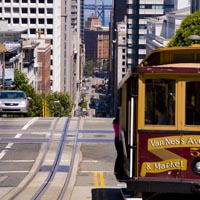 line goes past crooked Lombard Street. Both lines end at Fisherman�fs Wharf, the former on the east side; the latter on the west. The California line runs on California from Market to Van Ness and goes through Chinatown and past Grace Cathedral. All lines go up and down steep hills, a thrilling ride for novices.
F-Line streetcar. A great way to get to popular tourist destinations is on the vintage electric streetcars of the F-Line, serving popular Market Street, the Embarcadero, with links downtown to Fisherman�fs Wharf and Pier 39. Look for them at especially marked center islands along the route.
BART. Muni does not go to the airport. To get to and from the airport, or across to the East Bay (Berkeley, Oakland, Richmond and beyond), BART (Bay Area Rapid Transit), a subway and commuter rail, is a convenient way.
FERRIES. Destination ferries to Sausalito, Tiburon, Angel Island Oakland�fs Jack London Square, Alameda and Vallejo leave from Fisherman�fs Wharf or the Ferry Building. Most narrated ferry tours of the bay, and the popular Alcatraz ferry, depart from Fisherman�fs Wharf.
Accommodations
The opening of the opulent Palace Hotel in 1875 put the world on notice that San Francisco was a cosmopolitan city, ready to receive guests. Since then, the lodging industry has not disappointed. With choices as diverse as the city itself, an important part of the San Francisco experience is staying in one of its wonderful accommodations.
A large number of hotels with familiar names and smaller hotels, all of varying price ranges, are clustered around Union Square, close to shopping, dining, and attractions. Sleek high-rise ones with great views, like the Hilton and the Hyatt Regency, meet the corporate needs of the high tech Financial District. Family-friendly chain hotels with comfortable de�Lcor and amenities fit in with the activity of popular Fisherman's Wharf: the Marriott, the Sheraton, the Best Western Tuscan Inn, the Hilton and the Hyatt. Intimate boutique hotels and delightful Bed & Breakfasts are scattered in great locations throughout the city.
Some hotels are landmarks linked to San Francisco�fs Gilded Age: the Palace, dripping in crystal chandeliers; the Westin St. Francis, where royalty and presidents have stayed, the Sir Francis Drake, with Beefeater-attired doormen. The cre`me de la cre`me are on upscale Nob Hill: the Fairmont, exuding opulence, the Huntington Hotel, understated and discreet, Stanford Court, with unparallel service, the neoclassic Mark Hopkins.
Contemporary, ultra-luxurious hotels punctuate the skyline: the high-tech St. Regis, art-filled Ritz-Carlton, Asian-influenced Mandarin Oriental, elegant Four Seasons, sleek W San Francisco.
Boutique hotels with imaginative de�Lcor �|whimsical, retro, flashy, kitschy, or Zen-like �| mirror the city�fs diverse persona: the Clift Hotel, modern and minimal, the Argonaut with distinctive 1930s nautical de�Lcor, Hotel Palomar, artfully urban, the Art Nouveau Donatello. The de�Lcor in the Hotel Triton is funky, the ceilings in the Hotel Monaco are frescoed, the Orchard Garden Hotel is �ggreen.�h Hotel Griffon has a wonderful view, Hotel Drisco sits amid some of the city's most fabulous mansions in upscale Pacific Heights, and Hotel Vitale is a chic urban oasis.
Intimate European-style hotels with small, comfortable rooms, many in restored early 1900-era homes, are favorite places. With more reasonable rates and great character, some are antique-filled Victorians, yet others have interiors that are modern, sleek and urban. A stay in a delightful Bed & Breakfast, many housed in the city�fs famous Victorian Painted Ladies, offers warm, attentive service, sleeping under down comforters amid lovely antiques and fresh flowers. Each with distinct personalities, they are comfortable oases in an urban atmosphere. Some, like the Red Victorian Bed & Breakfast in Haight-Ashbury, are nostalgic tributes to another era.
When booking one of the many lodging choices, remember that room rates do not include the 14% tax rate and parking fees, which average around $48 per day. San Francisco is a popular year-round destination, with high season in the summer, and hotels filled any time by convention-goers, so be sure to call in advance of your visit.

Trust us, we've been there!
www.trustedtours.com